The World’s Largest Military Base Turns 250
On this anniversary, it is time to see the United States for what it has always been: an instrument of class rule and global domination, born in slavery and permanently at war.

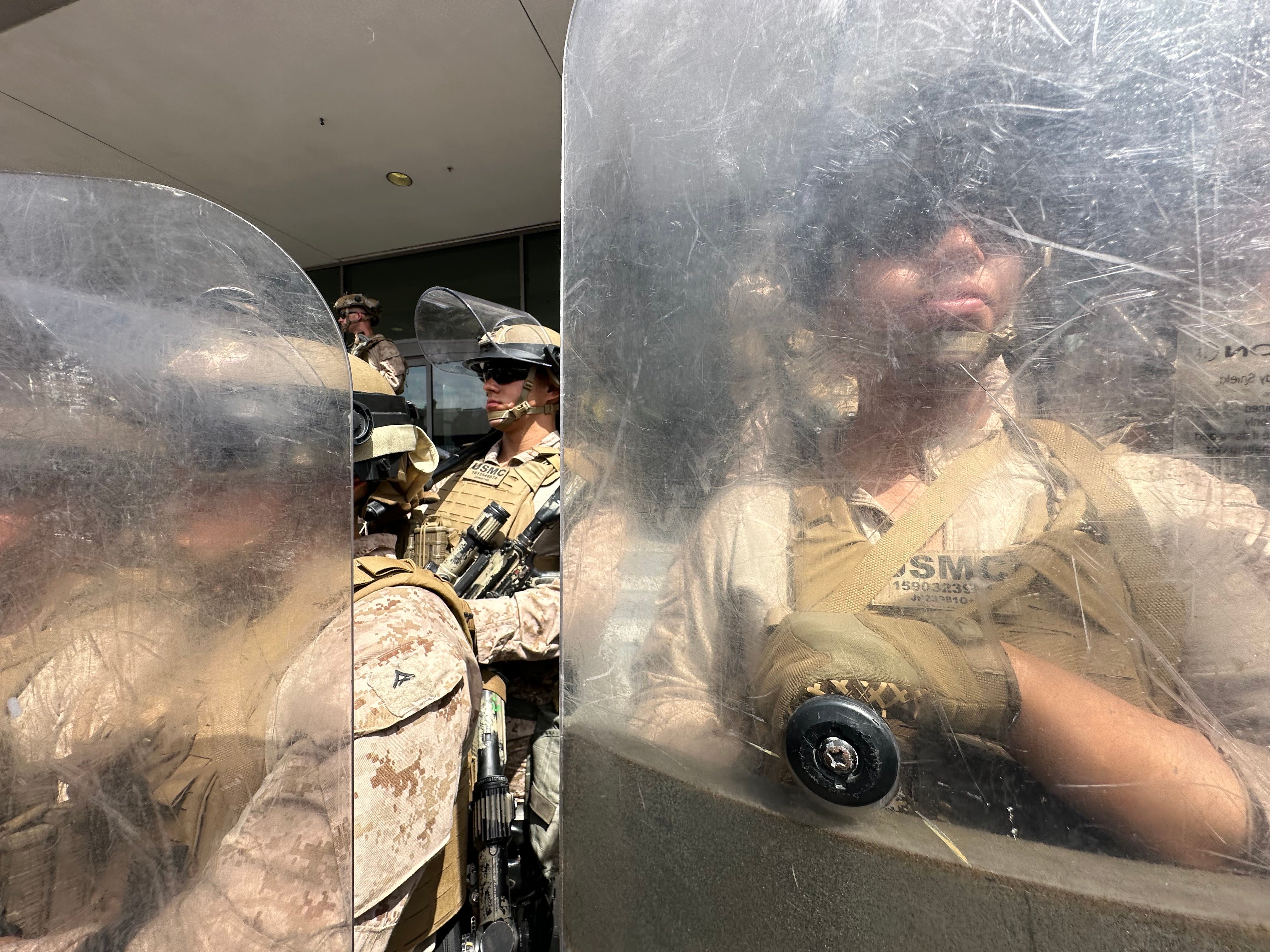
Today is the Fourth of July, once again. As fireworks burst over piers and parks, as militarized air shows trace the sky, the United States of America celebrates two and a half centuries of so-called independence. The official story will be reprised: a Brave New Republic, a beacon to humanity, conceived in liberty, broke free from the chains of the monarchal rule of the Old World. Many of us have noted the contradictions of this fable; how the man who wrote “all men are created equal” owned hundreds of human beings, how the right to “the pursuit of Happiness” rested on the land of exterminated peoples. But I believe we must go much deeper than this in our analysis. The country that emerged from the rebellion of 1776 was not a democracy but, what prolific historian Gerald Horne calls a counterrevolutionary project of slave-owning aristocrats, land speculators, and merchants who despised taxes because they rejected any restraint on their private accumulation.
Their praxis, from the very first day, was built on three interlocking pillars: the genocide of Indigenous nations, the enslavement of Africans, and the patriarchal subjugation of women; each a method of primitive accumulation, each a means of ensuring that their dictatorship of property would never be threatened by the potential for a republic of labor.
And because this fragile edifice could not survive without ceaseless expansion, the United States has been at war for nearly its entire existence, evolving over 250 years into something that is not a nation in any recognizable sense but a planetary military base that rules all oceans and oppresses all humanity with the triplet levers of bombs, coups, and sanctions.
To understand what the Fourth of July actually marks, one must strip away the civic religion. The men who gathered in Philadelphia in 1776 were, by and large, men of immense wealth. George Washington was one of the richest men in the colonies, his fortune resting on enslaved labor. Thomas Jefferson composed lyrical lines about equality while codifying racial hierarchy in his plantation ledger. The Revolution was not a rising of the dispossessed; it was a secession of the colonial ruling class, provoked less by abstract tyranny than by London’s attempts to limit westward speculation and, decisively, by the British Empire’s drift toward abolition.
When Lord Dunmore offered freedom to enslaved people who joined the Crown’s forces, the planters’ panic became violent extremist fervor. The Constitution that followed was an explicit instrument to protect private property against democratic progress: a federal government strong enough to suppress Shays’ Rebellion and the Whiskey Rebellion, to enforce debt collection, and to return liberated formally enslaved Black people to their white masters across state lines. The Founders’ hatred of taxes was not the cry of the oppressed but the demand of capital to be left alone with its spoils.
Racism, patriarchy, and genocide were not flaws in an otherwise noble experiment; they were its engines. Indigenous nations were dispossessed and massacred in a centuries-long campaign that Marxist geographers rightly call accumulation by dispossession; the literal clearing of space for the commodity frontier. The reservation system and the boarding school assimilation programs completed the process, converting sovereign peoples into a disposable internal colony. Chattel slavery supplied the uncompensated labor that built much of the early national wealth, its profits woven into the textile mills of New England and the banks of New York. And patriarchy, inscribed in law and custom, ensured the reproduction of a disciplined workforce and the private sphere of male authority that the state could rely on as its microfoundation.
When W.E.B. Du Bois called the post-Reconstruction settlement the “counterrevolution of property,” he named the enduring logic: each expansion of formal rights would be met with a reassertion of class domination, often draped in the flag of white supremacy.
This history of internal violence found its natural extension in foreign war. By the count of the Congressional Research Service, the United States has deployed its armed forces in hundreds of conflicts and interventions, and the country has been at war for more than 90 percent of its existence. The list is numbing in its monotony: the genocidal campaigns against Native nations; the war of aggression against Mexico that seized half its territory; the imperial conquests of 1898 in Cuba, Puerto Rico, and the Philippines; the Marine landings and coup d’états that dotted Asia, South America, the Pacific, and the Caribbean; two world wars fought as much to secure markets and strategic positions as to supposedly defeat fascism; the Cold War, which was less a frozen peace than a global counterinsurgency punctuated by Korea and Vietnam; the post–Cold War era of humanitarian pretext and unending, expanding war from Baghdad to the Sahel.
The so-called “peace dividend” never arrived. Instead, the military budget metastasized, and war became the permanent undertone of American life, its costs socialized, its profits privatized, its targets overwhelmingly brown and poor. The Pentagon’s seemingly infinite budget remains shrouded in mystery, unaccountable and with no oversight. A normal nation has a military that serves its government and economy. But in the military base of the United States: this relationship is reversed.
What makes the United States different from other imperial powers, what defines it in the world system, is not merely its belligerence but its structural transformation into a military base with a civilian facade. This unique setup has given way to a planetary empire of over 750 overseas military bases across some 80 countries, a Navy that commands every choke point on the planet’s oceans, a nuclear triad primed to incinerate the earth, and an economic surveillance apparatus that turns the dollar system into a weapon of mass sanction and starvation.
The domestic territory, the supposed free and democratic home front of the United States, functions largely as a logistics hub, a recruitment pool, and an arms factory. Dissidence from within crushed by a constantly expanding militarized police state. The Department of Defense, forcibly funded by taxpayers, is not a servant of the republic but the core institution of the state itself, the concentrated expression of monopoly capitalism’s need to absorb surplus, open markets, and discipline any country that dares to step off the path prescribed by Washington and Wall Street.
Sanctions are the quieter half of this permanent war. The “maximum pressure” campaigns against Cuba, Venezuela, Iran, Syria, North Korea, and dozens of other nations are not alternatives to war but forms of economic siege that devastate civilian populations, block medicine and food, and foreclose development—all without a single vote in Congress. They are enforced not by moral suasion but by the implicit threat of cruise missiles and aircraft carriers.
A country that attempts to trade outside the dollar system, nationalize its resources, or pursue an independent foreign policy faces the choice between slow strangulation and sudden bombardment. This planetary extortion racket is the real meaning of the Rules-Based International Order: the freedom of capital to move and extract, backed by the concentrated violence of a single hegemon that has substituted law with force.
If the United States is best understood as a worldwide military base, then Israel is its most distilled, most revealing iteration: our newest extension, where the logic of the garrison state reaches its most terrifying endpoint. Israel functions as an immense, nuclear-armed forward operating base, permanently anchored in the Middle East, fully integrated into the American military-industrial complex.
It is the test lab for counterinsurgency technologies and surveillance methods that are later exported across the globe. It is the recipient of unconditional diplomatic cover and a torrent of weapons, used not in self-defense but in the relentless ethnic cleansing of the Palestinian people, an ongoing Nakba genocide that mirrors with eerie precision the American westward march of military forts, broken treaties, and massacres of Indigenous villages.
The notion that Israel is a normal nation is the foundational myth that makes the arrangement possible. In reality, its existence is fundamentally dependent on external subsidies, arms transfers, and the protective umbrella of American power. It produces little for the global market beyond military hardware, spyware, and a booming industry of fear. Its political class understands that its only strategic value to Washington is as a permanently warring settler garrison, a crusader state whose declared mission of ethnic religious supremacy serves the empire’s need for a destabilized, divided, and petrol-rich region.
The same logic that settled the American frontier with Manifest Destiny; erase the native, fence the land, arm the settler, and wave a flag, now manifests in the settlements of the West Bank, the bombs falling on Gaza, the invasion of Lebanon, and the quiet nuclear arsenal at Dimona. The Israeli project is an active extinction machine, liquidating entire peoples in plain view, with the calculated risk that the wider conflagration could consume the region and, given the nuclear dimension, the species itself.
The United States is not a nation. Israel is not a nation. They are the hierarchies of a network of military bases that oppress humanity and threaten the species with extinction via endless conflict and the march towards climate collapse (their now conjoined militaries remain the largest polluters on the planet). From the genocide against Native Americans to the planned erasure of Palestine, from the firebombing of Tokyo to the forever wars of the twenty-first century, the American system has always pursued a logic of final solutions for those who stand in the way of accumulation.
These horrors are not the consequence of bad leaders or imperfect institutions but the necessary product of a social order based on private property, class exploitation, and the endless expansion of capital. The United States is the purest political form of that order in its imperialist phase: a state that abolishes the distinction between peace and war, that turns the globe into a carceral market, and that will sacrifice every living thing to maintain the privileges of a tiny owning class.
The 250th anniversary of the Fourth of July should be a moment of clarity, not patriotism. The task is not to recover some lost democratic essence but to recognize that the American experiment has been, from its first breath, a machine for the production of death on a continental and then a planetary scale. The only cause worthy of celebration is the centuries-long resistance of the enslaved, the colonized, the indigenous, the working classes—the global multitude that has fought back against this empire of bases, and that may yet build a genuine internationalism from its ashes. Until that day, the fireworks will remain what they have always been: the distant glow of a world on fire.